


Adjusting Gradients in Table Cells


J.G. wrote:
Imagine a table with three cells in one row. I fill the middle cell with a black-to-white gradient. However, that cell only appears filled with a portion of the gradient, as though all three cells were filled! How can I fill the cell with the whole gradient?
You are not the first person to be flummoxed by the way InDesign applies gradients inside text frames. Yes, I know you selected a table cell, but remember that tables are still always inside text frames. And when you apply a gradient swatch to anything in a text frame, InDesign “places” the gradient as though the gradient stretched across the entire frame.
In the following image, the second row of the table has a gradient that stretches across all three columns. Then, I selected the middle cell in the next row and applied the same gradient swatch:
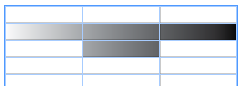
To force the blend to fit inside the cell, first select the cell (if the type cursor is flashing inside the cell, press the Esc key), then drag across the cell with the Gradient Tool. This applies a “local gradient formatting” to the cell.

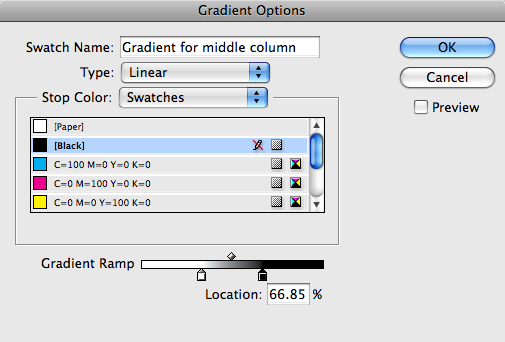
Of course, if you had to do a hundred of these, it might be easier to make a custom gradient swatch that simply started a third of the way over on each side:
Here’s another article on uses of the Gradient Tool.
 |
A quick way to apply styling to one cell is to paste a single cell table into the cell.
(Of course you’ll need to work out the spacing and insets…)
Please fix this problem. Adobe’s online user guide gives instruction on how to fill a cell with a gradient, but never mentions this bug.
Hi ,
Wonderful Post! I didnt thought that someone would explain about this the help of screenshots in this world of Geeks. Thanks a ton
Thanks for the information.
Is there also a way to fill a cell or row of cells with a 90 degree (vertical) gradient? Say, from black at the top to either white or transparent at the bottom? And then, apply this gradient to more or less alternating rows?
Is there even a way to select non-concurrent rows or columns in InDesign?
I am trying to duplicate this QuarkXpress-created form (shown here as a PDF) in InDesign.
https://www.gridironmen.org/images/Gridiron_Registration.pdf
@Ruth:
I did it this way ? it’s easy, just with the gradient tool and the eye dropper tool.
? first create a gradient swatch
? select a ?preferably empty? cell
? fill the cell with the gradient ? yes, it looks wrong
? drag vertically with the gradient tool within the cell boundaries, the gradient will look fine now
? now deselect all (apple-shift-a)
? click the eye dropper tool on the cell gradient fill
? drag the eye dropper tool on the cells you want to fill
That’s it!
Take care: deselecting is essential.
And clicking in a cell with the eye dropper may not have the desired effect, when you inadvertently activate text mode. So click near the border of the cell to access the cell background.
This is a HUGE issue. I do a lot of document production and to have to manually fill every table header is not an option. I wanted to do a vertical blend on the header row and could not figure out why it kept changing, until I realized that every time I added rows it changed.
I am not sure what good cell styling is if it is not limited to the cell. Every other program I work with does not seem to have a problem with this…
Has anyone every tried to create an image and embedded it as a vertical blend?
Hi there,
I am trying to add forward/backward slashes to individual cells in a table…
So far all get is one SINGLE line in my cell, but I want to have the entire cell filled with slashes on top of the cell background color…
Any suggestions on how to do this?
@Thomas: There’s no “fill with pattern” feature. You’d probably have to fill a cell with an image.
This was a great post. Very easy, very helpful. Thank you. :))